
Filtration pump
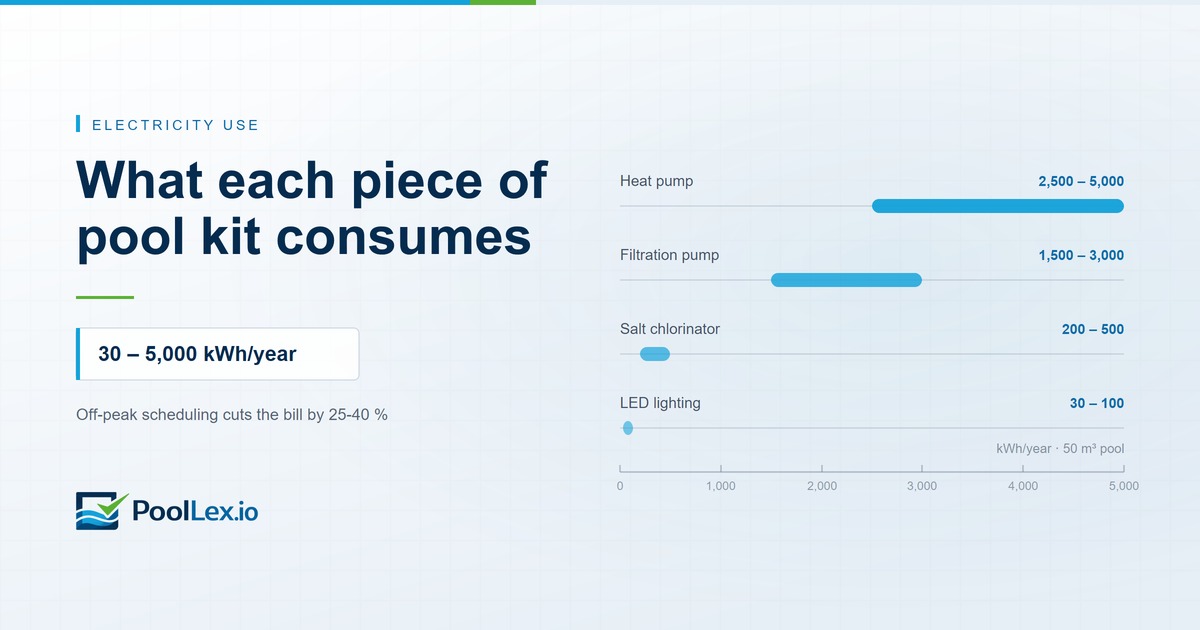
The filtration pump has the highest annual runtime and is the pool's largest non-discretionary electricity consumer. A single-speed pump of 0.75-1.5 HP running 6-8 h/day in season consumes between 1,500 and 3,000 kWh per year.
A well-programmed variable-speed pump (VSD) cuts that consumption by 60-80 %, mostly by running at reduced flow for most of the filtration period. It is the retrofit with the highest financial return in most refurbishments.
Heat pump
The heat pump concentrates most of the electricity cost in heated pools. Its performance is measured by the COP (Coefficient of Performance): a COP of 5 means that for every kWh of electricity consumed it delivers 5 kWh of heat to the water.
Typical consumption in a 50 m³ pool in temperate zone, extended season (May-October): 2,500-5,000 kWh per year. Without a thermal cover consumption can double due to overnight radiation and convection losses.
Lighting
Underwater lighting represents a small fraction of total consumption. Modern LED fixtures use 15-30 W per point versus 100-300 W for old halogens. In a pool with 2-4 fixtures and 3 h daily use in season, consumption is around 30-100 kWh per year.
Switching to LED is profitable but small in absolute impact: it cuts the annual bill by tens of euros, not hundreds.
Salt chlorination systems
A salt chlorinator draws 150-400 W while running. In a 50 m³ pool with 6-8 h daily chlorination in season, consumption is between 200 and 500 kWh per year.
It is a relevant but contained load — equivalent to an efficient filtration pump. The operating cost is offset by the savings from not buying chlorine tablets.
Tariff: off-peak vs peak
A pool's electricity bill depends both on consumption (kWh) and on the time when it is consumed. With time-of-use or indexed tariffs, the kWh price can range from €0.08/kWh off-peak to €0.25/kWh at peak.
Scheduling filtration and the heat pump mostly during off-peak hours (00:00-08:00 and weekends) can cut the pool's electricity bill by 25-40 % without changing any equipment. Compute your estimated consumption in our energy calculator and cross-check with your pool's technical sheet to find its estimated EN 17645 class.