
Basic calculation formula
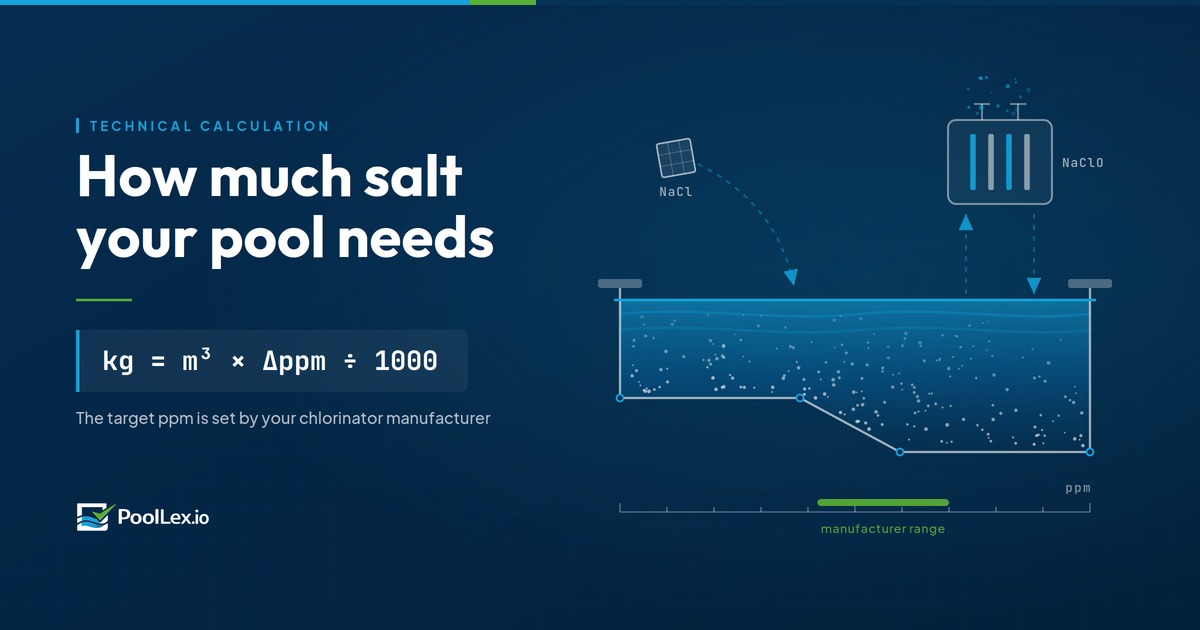
The salt quantity needed for a pool with a salt chlorinator is based on the water volume and the target concentration. The formula is:
Salt (kg) = Volume (m³) × Target concentration (g/L) / 1000
Most residential salt chlorinators work between 3 and 5 g/L (3,000 to 5,000 ppm). For a 50 m³ pool with a 4 g/L target the calculation is: 50 × 4 = 200 kg of salt. Run the exact numbers for your pool at our salt calculator.
When to add salt
Salt is added in two typical situations:
- Initial start-up — first charge after filling or draining, the entire calculated amount goes in at once.
- Periodic top-up — to compensate for salt lost through splashing, backwashing and partial drain-downs.
Salt is not consumed by the electrolysis process — it cycles continuously between active chlorine and sodium chloride. It only drops through physical water losses.
Common mistakes
- Confusing table salt with pool salt — pool salt is pure NaCl >99.5 %, without anti-caking agents or iodine, which damage the cell.
- Adding salt with the chlorinator on — can cause chlorine spikes and cell damage. Turn off for 24 h and dissolve fully before restarting.
- Dosing on theoretical volume instead of real — a pool that has lost water to evaporation has less volume than the label suggests.
- Dropping salt at a single point — spread it over the whole surface to speed dissolution and prevent bottom accumulation.
TDS and pH: how salt affects them
TDS (Total Dissolved Solids) measures every dissolved solid in the water, including salt. With a salt chlorinator the target TDS sits between 3,500 and 5,500 ppm. Above 6,000 ppm corrosion risk on metallic parts (ladders, lights, screws) starts to appear.
pH tends to rise in salt-chlorinated pools because of hydrogen release from the electrolysis process. Periodic dosing of pH reducer (sodium bisulphate or diluted hydrochloric acid) is standard to keep it between 7.2 and 7.6.
Monthly maintenance
Check the salt concentration monthly with test strips or photometrically, and top up when it drops more than 10 % below the chlorinator manufacturer's recommended level. Log every reading to keep a TDS drift history and detect abnormal water losses.
To size top-ups accurately use the salt calculator and combine it with the water calculator if you need to estimate the current volume after evaporation or backwash.